Shop by Category

- 0
Your Basket
Your basket is empty.
a37a2d923844ef18e864bfe3b59e2917
Home › Car clip guides › Cable ties, hoses and washers
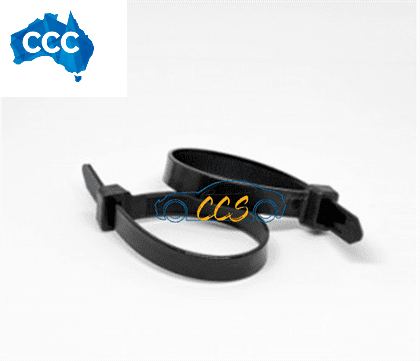
Cable ties are one of the handiest things in a car toolbox: wiring for lights and accessories, loose hoses, trailer plugs and looms that have dropped. A few habits make the job last longer and look neater.
Sunlight breaks down plain nylon over time. Black UV-stabilised ties are the usual choice for anything outside the cabin, including the engine bay, chassis and roof racks. See black UV cable ties.
Nylon ties have a temperature limit, and the hottest parts of the engine bay (exhaust manifolds, turbos, exhaust pipes) are beyond it. Route wiring and ties well away from them, and check the rating on any tie you use near heat.
Do not let a tie or the wiring it holds rub on a sharp edge, and keep looms clear of the steering, belts and fans. Leave a little slack where wiring crosses from the body to the engine, which moves on its mounts.
Where there is no rail to tie to, use a push type cable tie that locks into a panel hole, or a mountable tie that screws on. For small hoses, a tie can also secure a hose joiner.
Pull the tie snug, not crushing. Trim the tail flush with cutters or a tie tool so there is no sharp end to cut hands later.
Narrow ties for light wiring, medium for looms and hoses, wide for heavy bundles. Our cable tie sizes guide explains it.
For wiring, a tie every 150 to 300 mm keeps a loom neat without strain. Add one either side of any bend, and one where the wiring passes through a grommet.
Cut the tie at the head with side cutters or flush cutters, away from the wiring. Do not use a knife pulled towards the wiring.
| Job | Typical width | Notes |
|---|---|---|
| Fine wiring, dash cam leads | 2.5 to 3.6 mm | Small heads fit behind trims |
| Engine bay and trailer wiring | 3.6 to 4.8 mm | Black UV-stabilised, away from heat |
| Hoses, tarps, roof loads | 7.6 to 9 mm | Longer lengths for larger bundles |
| Heavy bundles, 4WD fit-outs | 9 to 12.7 mm | Check the tie suits the load |
See the full list of widths and lengths in our cable tie size guide, and use push-mount cable ties where there is a hole but nothing to tie to.
Black UV-stabilised ties are made for outdoor use and handle sunlight better than natural nylon. Check the product description for the tie you buy.
No. Keep nylon ties well away from exhaust manifolds, turbos and exhaust pipes.
Sizes and fitting steps in our guides are general. Check your vehicle's manual for anything specific to your car. Questions? Call 0499 001004.
When buying 2 or more packets of the same item
| Qty | Tier 1 | Tier 2 | Tier 3 |
|---|---|---|---|
| 1 packet (25pcs) | $12.95 | $14.95 | $20.95 |
| 2+ packets (50pcs) | $11.95 | $13.95 | $19.95 |
| 4+ packets (100pcs) | $8.95 | $10.95 | $16.95 |
Price per packet. Packets sold in 25pcs per packet.
Pricing may change on each page of the website.
All pricing includes GST. All discounts received at checkout.