Shop by Category

- 0
Your Basket
Your basket is empty.
a37a2d923844ef18e864bfe3b59e2917
Home › Car clip guides › Clip types explained
Pop rivets join two parts from one side. On cars you will see two kinds: plastic (nylon) rivets that hold trim and liners, and metal blind rivets that hold brackets and fittings. They are not interchangeable.
A plastic pop rivet has a split nylon body and a long pin. Setting the pin spreads the body behind the panel. They are light, will not rust, and are easier to remove later. Use them on mud flaps, arch liners, trim and light panels. See plastic pop rivets.
A metal blind rivet is set with a rivet gun. The mandrel pulls the body tight behind the panel and snaps off. They are stronger and permanent. Use them for brackets, heat shields and fittings such as fuel lids. See metal pop rivets.
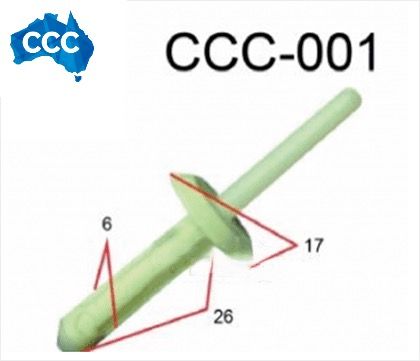
Our product pages list the sizes shown on each photo. See how to measure a car clip.
Drill out metal rivets through the head with a bit just smaller than the rivet, then tap the rest out. For plastic rivets, cut or lift the head and push the body through. Try not to make the hole bigger, or the new rivet will be loose.
Use what the car came with. If a plastic panel was riveted with plastic, a metal rivet can crack it. If a bracket was metal riveted, a plastic one will not be strong enough.
| Plastic pop rivet | Metal pop rivet | |
|---|---|---|
| Tool needed | None, or a trim tool to remove | Pop rivet gun, drill to remove |
| Removal | Easy | Must be drilled out |
| Typical use | Liners, trims, splash shields | Trays, brackets, metal panels |
| Corrosion | Does not rust | Check the metal suits the panels |
Our plastic pop rivets have stems of about 4 to 7 mm. Our metal pop rivets have stems of about 4 to 6 mm. The stem size is the drill size you need, so check it before you drill out an old rivet.
| Product | Type | Head (mm) | Stem (mm) | Length (mm) |
|---|---|---|---|---|
| CCS-0001 | Plastic | 17 | 6 | 26 |
| CCS-0002 | Plastic | 20 | 6 | 18 |
| CCS-0003 | Plastic | 15.5 | 4 | 24 |
| CCS-0004 | Plastic | 18 | 7 | 23 |
| CCS-0005 | Plastic | 12.2 | 4.9 | 17 |
| CCS-0007 | Plastic | 9 | 5 | 15 |
| CCS-0008 | Plastic | 17 | 6 | 25 |
| CCS-021 | Metal | 9 | 4 | 6 |
| CCS-022 | Metal | 9 | 4 | 10 |
| CCS-024 | Metal | 13 | 6 | 15 |
| CCS-027 | Metal | 11 | 5 | 22 |
| CCS-028 | Metal | 13.8 | 4.7 | 18.5 |
| CCS-043 | Metal | 16 | 4.8 | 20.8 |
| CCS-044 | Metal | 10 | 4.8 | 20.8 |
Sizes are approximate, read from the measurement marks on our product photos. Always compare with your original part.
Only where the joint does not need the strength of metal, such as a trim. Keep metal rivets on load-bearing joins.
Sizes and fitting steps in our guides are general. Check your vehicle's manual for anything specific to your car. Questions? Call 0499 001004.
When buying 2 or more packets of the same item
| Qty | Tier 1 | Tier 2 | Tier 3 |
|---|---|---|---|
| 1 packet (25pcs) | $12.95 | $14.95 | $20.95 |
| 2+ packets (50pcs) | $11.95 | $13.95 | $19.95 |
| 4+ packets (100pcs) | $8.95 | $10.95 | $16.95 |
Price per packet. Packets sold in 25pcs per packet.
Pricing may change on each page of the website.
All pricing includes GST. All discounts received at checkout.